
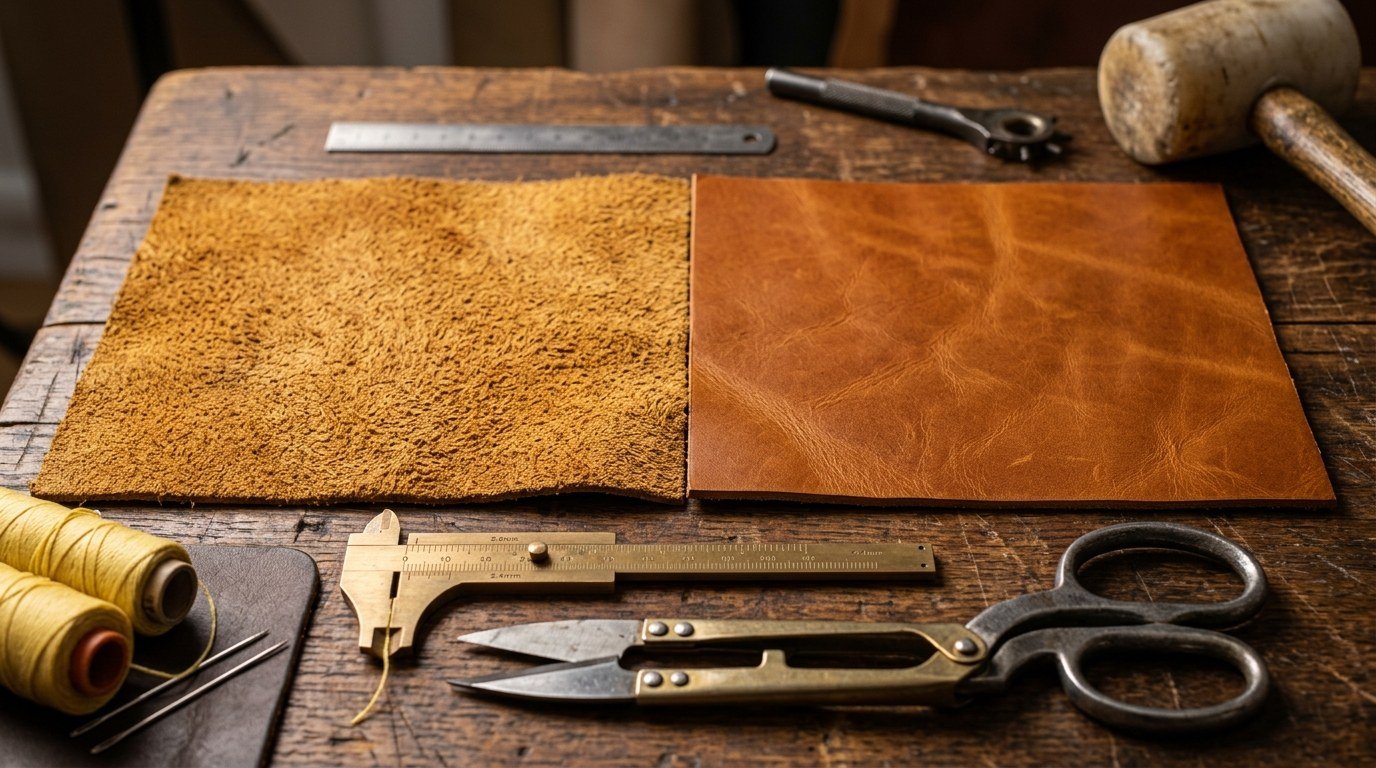
When safety managers and international distributors order work gloves and protective apparel, the most consequential technical decision is selecting between Split Leather and Top Grain Leather. While both originate from bovine hides, their structural fiber orientation, surface chemistry, and physical performance characteristics could not be more different.
1. Bovine Hide Anatomy & The Splitting Machine
A raw bovine hide harvested from mature cattle measures anywhere from 4.0mm to 6.5mm in total thickness. Because this raw state is far too dense and rigid for wearable safety gear, the hide passes through high-precision motorized splitting band-knives at our Kolkata tanneries, slicing the cross-section into distinct horizontal layers:
The outermost layer of the hide, where hair follicles and dense horizontal collagen fibers reside. This dense outer surface retains the animal's natural grain pattern, forming a tough, flexible shield that naturally repels water, machine oils, and grease.
The fibrous inner layer remaining after the top grain is shaved off. It features dense, omnidirectional collagen fiber bundles on both sides. This creates a suede-like nap with high mechanical friction and exceptional natural heat dissipation.
2. Split Cowhide: The King of Heavy Welding & Foundry Work
Split cowhide is the undisputed global benchmark for heavy industrial welding, smelting, and heavy material handling. Its key advantages include:
- Superior Thermal Absorption: The open, fibrous structure of split leather acts as a natural heat sink, preventing conductive heat transfer to the worker's hand. Molten spatter bounces off or solidifies on the fibrous surface without burning through.
- High Slip Friction: Unlike slick smooth leather, the textured nap of split leather provides a secure, non-slip grip on oily steel pipes, heavy structural I-beams, and rugged machinery handles.
- Exceptional Tear Resistance: The interlocking collagen bundles resist tearing when snagged against jagged stamped metal edges or concrete blocks.
- Cost Efficiency: Because the grain layer is removed, split leather offers the highest protection-to-cost ratio, allowing large fabrication yards to replace gloves economically.
3. Top Grain Cowhide: Fluid Repellence & Mechanical Dexterity
Top grain leather is selected when workers encounter wet, oily, or dynamic handling environments:
- Natural Barrier Against Liquids: The sealed grain structure resists water, hydraulic oils, and petroleum greases that would rapidly soak into fibrous split leather.
- Supple Flexibility: Grain leather conforms closely to the hand's natural contours, minimizing hand fatigue during repetitive gripping, valve operation, and rigging maneuvers.
- Smooth Exterior: Dirt, metal shavings, and wet slurry wipe clean easily from the slick grain surface, preventing cross-contamination in clean assembly plants.
4. Specialty Hides: Grain Goatskin & Dense Buffalo Leather
Beyond standard cowhide, specialized industrial sectors demand alternative hides with distinct physical characteristics:
Grain Goatskin (The Precision TIG Standard)
Goatskin contains the highest natural lanolin content of any commercial leather. This keeps the hide permanently supple, preventing cracking even after repeated sweating and drying cycles. Goatskin possesses exceptional tensile strength per millimeter of thickness, allowing gloves to be crafted at 0.8mm gauge for unmatched fingertip dexterity.
Water Buffalo Split (Maximum Heavy Duty Abrasion)
Buffalo leather features a coarser, thicker fiber structure than bovine cowhide. While slightly stiffer initially, buffalo split exhibits extreme puncture resistance against wire rope strands, rebar ties, and foundry castings.
5. Industrial Material Comparison Matrix
Safety procurement officers can utilize the engineering performance matrix below to specify the optimal hide grade for their work environments:
| Hide Grade | Gauge Range | Heat / Spatter Barrier | Oil / Fluid Resistance | Tactile Dexterity | Relative Sourcing Cost |
|---|---|---|---|---|---|
| Heavy Split Cowhide | 1.2mm – 1.4mm | Extreme (High Spatter) | Low (Porous) | Moderate | Cost-Effective ($) |
| Top Grain Cowhide | 1.1mm – 1.3mm | Moderate (Radiant) | Excellent (Naturally Sealed) | High | Premium ($$$) |
| Grain Goatskin | 0.8mm – 1.0mm | Low to Moderate | Moderate (Lanolin) | Ultra-High (Class 5) | Specialized ($$$) |
| Buffalo Split | 1.3mm – 1.6mm | Extreme | Low | Low to Moderate | Economical ($) |
6. Recommended Hide Pairing by Industry
Maximum heat sink capacity, long gauntlet cuffs, and 4-ply Kevlar® welted seams.
Shirred elastic wrist, keystone thumb, and oil-resistant palm for grip on controls and steering wheels.
0.8mm gauge for precise tactile feedback when feeding delicate welding filler rods.
Double palm patches, aluminized thermal gauntlet, and heavy cotton fleece lining.
Source Direct From Kolkata's Primary Leather Manufacturer
Whether your safety program requires heavy-gauge split cowhide or precision grain goatskin, PNB Leather delivers factory-direct container shipments tailored to your specific leather grading, custom sizing, and branding specs.